

HACCP Training: The Front-Line Defense Against Persistent Pathogen Colonies in Food Manufacturing Facilities
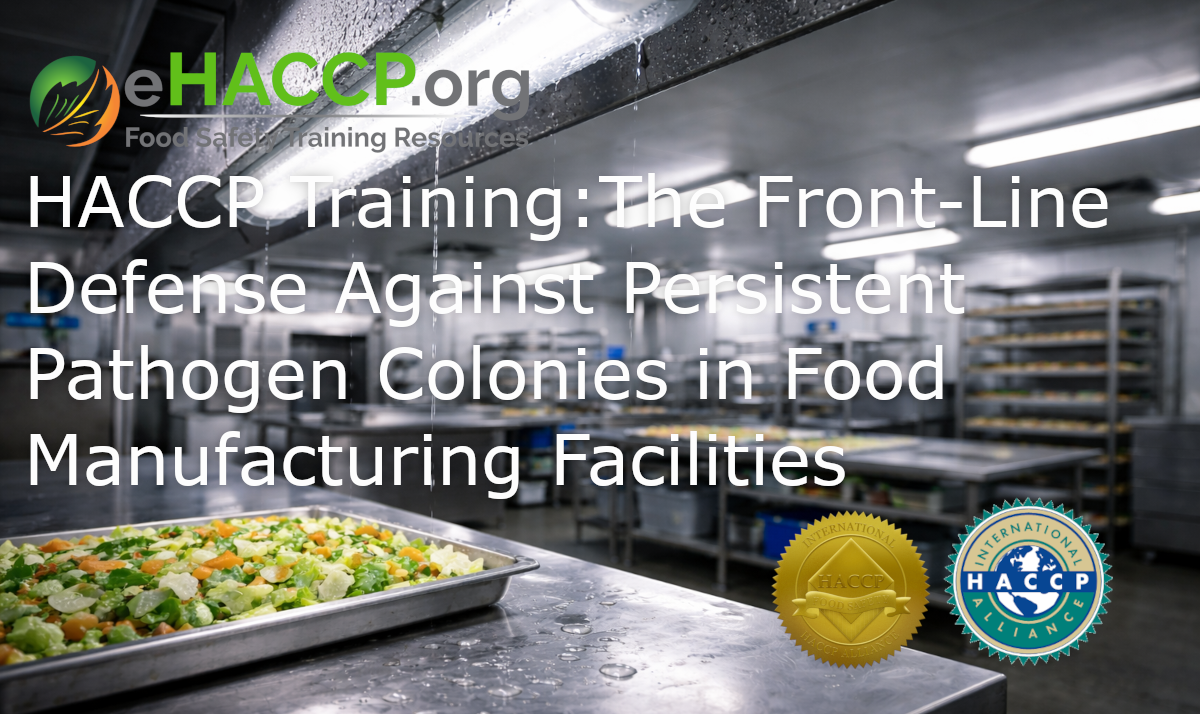
Persistent Pathogen Colonies in Food Manufacturing Facilities
HACCP Certificate of Completion
Scenario-based training across all 12 HACCP steps, eHACCP.org strengthens PRP control, reducing hidden contamination risks and improving compliance.
Persistent pathogen colonies are specialized, often slow-growing bacterial or viral populations that evade host immune responses and antibiotic treatments, leading to chronic, latent, or long-term infections. These, "persisters," often enter metabolically inactive states or hide within host cells (e.g., macrophages, biofilms), allowing them to survive for years and cause relapsing diseases.
A “Niche” Habitat usually has moisture or condensation, food residues or biofilms, limited exposure to cleaning, rough, cracked, or porous surfaces, and has warm or moderate temperatures.
Together, these conditions support biofilm formation, where bacteria embed themselves in a protective matrix that resists sanitizers. Biofilms are a slimy layer of bacteria encased in a protective matrix. They are dangerous because they can be up to 1,000x more resistant to sanitizers and can continuously release bacteria.
Some of the most effective ways of controlling biofilms are by the application of mechanical scrubbing, using biofilm-targeting cleaners, and increasing verification (ATP, swabs, etc.)
Areas of most concern are:
• Drains & Wet Areas (Classic Pathogen Niches) are super risky because of the constant moisture, lots of organic debris accumulation, and they are rarely fully sanitized internally. You’ll find the most common pathogens persisting in these areas, like Listeria monocytogenes, Salmonella, E. coli,
The best way to control these areas and pathogens is by having and employing dedicated drain-cleaning tools, foaming or enzymatic cleaners, and performing routine deep disassembly where possible.
• Cracks, Crevices & Equipment Harborage Points are also risky areas because they can be tiny spaces that protect bacteria from sanitizer contact. Food particles/soils can get trapped and rot. Places like worn gaskets, hollow rollers, loose bolts, and cracked plastic make excellent breeding grounds.
Effective ways to control these areas are by replacing damaged parts, designing equipment with hygiene in mind, and conducting regular teardown sanitation activities.
• Condensation zones and overhead structures pose significant risks due to the fact that liquid can drip from these areas, and dripping water spreads pathogens and is often overlooked during cleaning. Areas such as cooling-unit drip pans, ceilings over production lines, and pipes and ducts should be considered.
By employing effective controls like insulation, condensation management, and routine overhead sanitation and maintenance, biofilms in these areas will be dramatically reduced or wiped out altogether.
• Non-food contact surfaces near food, like conveyor frames, control buttons, forklift tires, walls, and doors, are also ripe for contamination and are ideal locations for pathogens to breed and multiply. Pathogens migrate from these surfaces to food-contact areas via hands, tools, or splashes and are likely to cause a foodborne illness outbreak.
It’s very important to consider niche habitats in food safety because they will cause repeated positive environmental swabs, recurring contamination events, product recalls, regulatory non-compliance, and, in the worst possible cases, cause illness.
Many food safety outbreaks are not born from a single missed step or an isolated sanitation lapse. Instead, they are the result of long-standing harborage sites, hidden microbial strongholds that quietly persist within facilities for weeks, months, or even years. These persistent pathogen colonies evade routine cleaning, reseed production areas, and create a cycle of contamination that cannot be solved with surface-level fixes alone. True prevention requires deeper visibility, smarter facility design, and a relentless focus on identifying and eliminating these hidden threats before they become headline news.
By using proper training that teaches the detailed overview and solutions of the who, what, where, why, and how of each PRP, like eHACCP.org does, using real life scenrios for each of the 12 steps of HACCP, each student learns to take on the ownership persona that is so important in considering these niche environments within their facility.
Stephen Sockett
eHACCP.org
+ +1 866-488-1410
email us here
Visit us on social media:
LinkedIn
Facebook
YouTube
X
Other
Legal Disclaimer:
EIN Presswire provides this news content "as is" without warranty of any kind. We do not accept any responsibility or liability for the accuracy, content, images, videos, licenses, completeness, legality, or reliability of the information contained in this article. If you have any complaints or copyright issues related to this article, kindly contact the author above.
